







How to Choose Safe Toys for All Ages in the UK | UK Toy Safety Guide


Buying or selling safe toys UK for children is not just a matter of choice, it is a big responsibility. While toys are helpful in a child’s development, they can be dangerous if chosen carelessly. The UK market in particular has strict toy safety regulations that are slightly different from international markets.
As an experienced UK Toy Wholesaler, I constantly see how parents and small retailers often overlook the finer points of safety. In this guide, we will discuss in detail the UK laws, age-based toy selection rules and safety standards, which will help you make the right decision.
Why Toy Safety Matters for Children of All Ages
Children’s abilities and curiosity vary at different stages of physical and mental development. So there is no “one size fits all” when it comes to toys. A toy that is educational for a 3-year-old may be a choking hazard for a 1-year-old.
Thousands of children in the UK are treated in hospital every year for toy-related injuries. There is a risk of injury from suffocation from careless toy selection, cuts from sharp edges or from harmful chemicals in batteries. Choosing toys according to age can reduce these risks by around 90%.
It is important to choose toys according to age because it is consistent with the child’s motor skills and mental intelligence. Toys for the wrong age can frustrate a child or pose a threat to his safety.
UK Toy Safety Regulations You Must Know
There are certain laws that must be followed when selling toys in the UK market. If you are a conscious buyer or retailer, it is very important for you to know these things.
What Are the Toy Safety Regulations in the UK?
Currently, the UK has the Toys Safety Regulations 2011 as the main law. The main aim of this law is to ensure that toys do not pose a threat to the health and safety of children. Under this, all toys must comply with the EN71 standard.
- EN71-1: Tests mechanical and physical properties.
- EN71-2: It tests how quickly the toy can catch fire or flammability.
- EN71-3: Tests for chemicals or heavy metals such as lead or arsenic used in toys.
UKCA vs CE Mark – Are Both Valid?
After Brexit, the UK’s own safety marking is UKCA. However, the UK government is currently allowing the sale of products with the CE mark until 2027.
- Retailers Note: If you sell toys in Great Britain (England, Scotland, Wales), you must have the UKCA mark after 2027. The CE mark is still valid for Northern Ireland.
- Consumers Note: When purchasing, make sure there is at least one marking on the packaging.
The Role of Trading Standards
In the UK, toy safety is monitored by Trading Standards. If a toy breaks these laws, it is removed from the market. As a trusted wholesaler, we regularly follow Trading Standards guidelines to ensure that the product that reaches you is legally valid.
Toy Safety Symbols Explained With Meaning
The symbols on the packaging are not just design, they are life-saving signals.
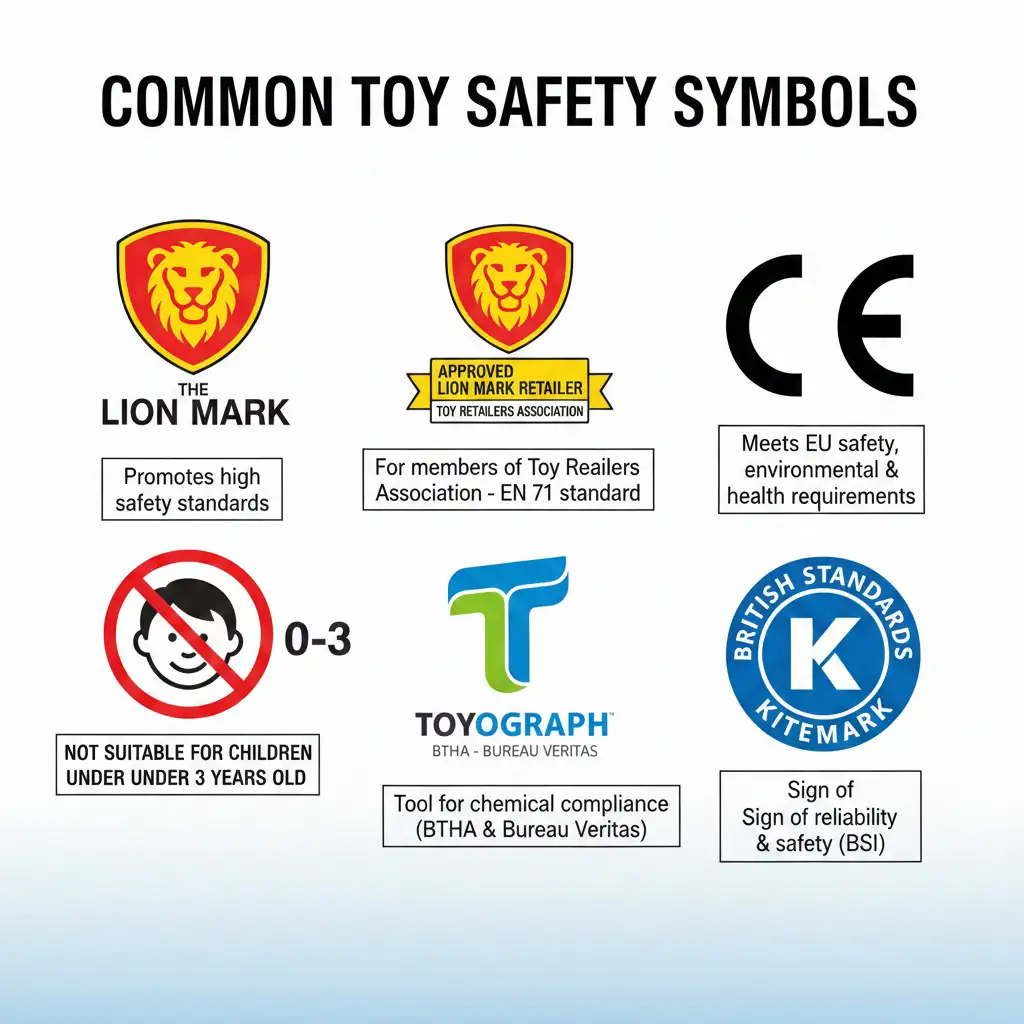
- 0-3 Warning Symbol: The symbol with the words ‘0-3’ written in a red circle and cut out means that the toy is extremely dangerous for children under 3 years of age. It is usually given if there are small parts or a choking hazard.
- UKCA / CE Mark: Having this mark means that the toy has passed all legal safety tests.
- Lion Mark: This is a special mark from the British Toy & Hobby Association (BTHA), which ensures the highest quality of toys.
Does CE mean non-toxic? No, the CE or UKCA mark does not directly mean ‘non-toxic’. It basically indicates that the toy has met all legal European or British safety standards, including the prevention of poisoning.
Essential Toy Safety Checklist Before Buying – UK Parents’ Guide
Before you order toys in stores or online, check out this checklist. As an expert, my advice is to never skip these 6 things:
- Small Parts: If the toy fits through a toilet paper roll, it is not safe for small children.
- Button Batteries: Make sure the battery compartment is locked with screws. Lithium coin batteries can cause serious stomach injuries.
- Magnets: Small, powerful magnets should not be kept within the reach of children.
- Strings and Loops: The strings of pull-along toys or musical toys should never be longer than 12 inches or 30 cm, as this poses a risk of entanglement in a child’s throat.
- Materials: Always look for BPA-free and non-toxic plastics.
- Durability: Is the toy sturdy? If a plastic toy breaks easily into sharp pieces when dropped, it is of poor quality and unsafe.
If you know the full UKCA guideline, read our Wholesale Toy UKCA Compliance post.
How to Choose Safe Toys by Age Group
As children grow older, their play style also changes. Here are age-based guidelines, as suggested by experts:
Babies (0–12 Months)
Children at this age put everything in their mouths, so toys should be large and soft.
- 5 by 5 rule: Toys should be at least 5 cm long and 5 cm wide to prevent swallowing.
- 5-8-5 rule: This is mainly a guideline for input voltage and safety, but for young children, it is more important to check the stability of the surface.
Toddlers (1–3 Years)
Sturdy plastic or wooden toys are good for children this age, but make sure the paint doesn’t come off and there are no small parts that can come off.
Preschool & Older Children (4+)
For children aged 4 years and above, marbles or Lego sets with small parts can be given.
- What age are marbles safe? Marbles or small spheres are completely prohibited for children under 3 years of age. It is safe to use from the age of 4 under adult supervision.
Toy Storage, Inspection & Maintenance
Safety doesn’t just end with the purchase. Toys need to be maintained regularly.
- Keep toys for older children and toys for younger children in separate baskets.
- Clean toys regularly and check for broken items.
- Wash soft toys occasionally to avoid allergies from dust.
Popular Toy Rules Explained – 10 Toy Rule, 20 Toy Rule
Many people ask how many toys should be given to a child at a time.
- 10 Toy Rule: This is a concept where only 10 toys are placed in front of the child at a time so that he can concentrate.
- 20 Toy Rule: It is mainly used for decluttering or organizing toys. Having more than 20 toys can cause ‘choice paralysis’ in a child.
Why Buying Toys from a Trusted UK Wholesaler Matters
The source is very important when choosing toys. Sometimes, cheap toys are available in online marketplaces that have no legal traceability.
As a trusted UK Toy Wholesaler, we verify the source and test reports of each toy. At SDMAX, we ensure that each of our products is UKCA and CE compliant. We don’t just sell toys, we ensure the safe and quality childhood of British children. Every toy we supply is rigorously lab-tested and suitable for the UK market.
Conclusion
Your child’s safety is in your hands. It is much more cost-effective to buy a safe and certified toy than a cheap one, as it reduces the risk of accidents. Always look for the UKCA/CE mark and age rating when buying toys.
Visit the SDMAX website to see a huge collection of safe and premium-quality toys. We have been supplying 100% compliant toys across the UK.